I read an interview, probably from NPR, but I can’t find it at the moment. The upshot was that caring for infants is insanely expensive, since they need one-on-one care pretty much continuously.
But parents can’t afford that cost, so, essentially, the price they charge for infant care is a loss-leader, and parents of older children (who need less supervision and thus more favorable staffing ratios) subsidize the cost of caring for infants. Daycare operators are barely keeping afloat.
yucky, just like with MDs/nurses, MDs are being snatched up by teledoc and PE firms. so there is less private or specialists out there. the only other “common” one is based on a scam condition(chronic lyme)


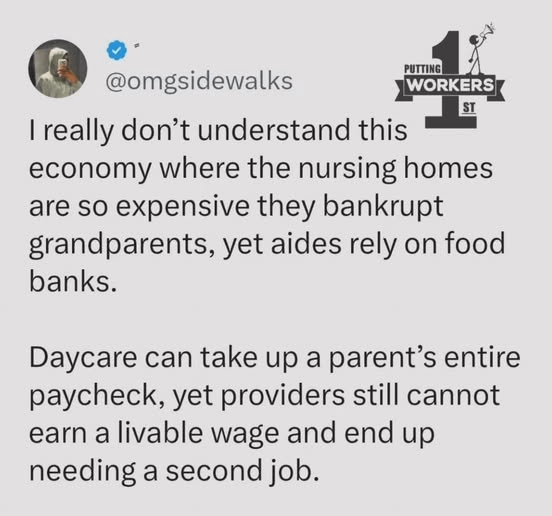
I read an interview, probably from NPR, but I can’t find it at the moment. The upshot was that caring for infants is insanely expensive, since they need one-on-one care pretty much continuously.
But parents can’t afford that cost, so, essentially, the price they charge for infant care is a loss-leader, and parents of older children (who need less supervision and thus more favorable staffing ratios) subsidize the cost of caring for infants. Daycare operators are barely keeping afloat.
Edit: Ah, here it is: Baby’s first market failure
Feels like this would be solved with longer parental leave, but what do I know?
They may require 1-on-1 interaction, but generally the ratio for 0-2’s is around 1:4.
And many childcare companies are owned by huge multi-billion dollar investment firms because they are cash generators.
yucky, just like with MDs/nurses, MDs are being snatched up by teledoc and PE firms. so there is less private or specialists out there. the only other “common” one is based on a scam condition(chronic lyme)
This is the only answer that is not just a hand waiving “investors bad”.
Are they required to provide for the more costly babies?