

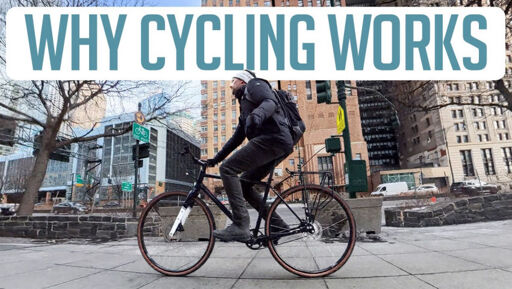
I’ve been lucky enough in the past few years to have ridden my bike in a bunch of cities all over the world. Looking back, here are lessons about urban cycling I learned from 12 different ones. Thi…
Personally I agree with his assessment of bicycling here in Germany where I live.
And for all of you who prefer reading to watching videos, I let AI generate a transcript summary.
1. Montreal: Small changes build over time
- The Lesson: Incremental improvements accumulate into significant transformation.
- Context: The speaker describes Montreal as the city that changed their perspective on cycling. Unlike the “battle” mentality of car-centric commuting, Montreal offered safe, separated infrastructure.
- Key Details:
- The city has been building bike lanes since the 1980s.
- Regular visits show constant expansion of the network, better connectivity, and the addition of pedestrian spaces.
- It represents a gradual reprioritization of public space away from automobiles.
2. Paris: It is about priorities, not space
- The Lesson: Cities do not need to find new space; they must reallocate existing space based on new priorities.
- Context: Paris underwent a rapid transformation from a car-clogged city to a bike city.
- Key Details:
- Transformation involved reallocation rather than “nipping and tucking.”
- Example: Rue de Rivoli was converted from car dominance to mostly bike use, with only one lane for taxis, buses, and deliveries.
- This demonstrates that rethinking the use of existing space can create “magical” urban environments.
3. New York: Political courage is essential
- The Lesson: Changing the status quo requires political will to fight entrenched paradigms.
- Context: Changing infrastructure in New York is uniquely difficult due to it being a media capital where everything is amplified.
- Key Details:
- Improvements like bike lanes and congestion pricing challenge 75 years of car-centric habits.
- Example: The congestion pricing debate showed how political capital must be invested to achieve results (reduced traffic, increased transit use, quieter streets).
4. London: Benefits extend beyond transportation
- The Lesson: Cycling infrastructure improves the city for everyone, not just cyclists.
- Context: London’s “cycling superhighways” have catalyzed broader positive changes.
- Key Details:
- Safety: Separated lanes make streets safer for motorists too by calming traffic and reducing speeds.
- Economy: Businesses benefit as it is easier for customers to stop at shops by bike than by car.
- Health: Central London saw a 53% drop in harmful nitrogen dioxide levels due to low emission zones and reduced traffic.
5. Edmonton: Better cities can happen anywhere
- The Lesson: Even cities historically designed around cars can transform themselves.
- Context: Edmonton is a sprawling, postwar North American city with a cold climate, often assumed to be resistant to change.
- Key Details:
- The city is a leader in undoing car-centric damage through zoning reform, removing parking minimums, and investing in transit.
- These changes have contributed to affordable housing and better public spaces, proving that change is possible regardless of a city’s starting point.
6. Seattle: Think creatively about space
- The Lesson: Overlooked or forgotten spaces can be transformed into vital public amenities.
- Context: Seattle is rainy and hilly, yet ranks highly for cycling.
- Key Details:
- Example: The Burke-Gilman Trail was created from a decommissioned railroad in the 1970s.
- Instead of selling the land off, it became one of the world’s first “rail trails.”
- This demonstrated the vision to see forgotten infrastructure as a way to transform daily life and connectivity.
7. Oulu, Finland: You can build winter cycling cities
- The Lesson: Climate is not a barrier; infrastructure commitment is.
- Context: Located near the Arctic Circle, Oulu is snowy and dark for much of the year yet is a world-class bike city.
- Key Details:
- The network prioritizes bikes over cars and is well-lit for dark days.
- Maintenance is prioritized: plow crews maintain a packed snow foundation for traction.
- Users are “normal” people (families, students, elderly), not just hardcore cyclists.
8. Ottawa & Washington D.C.: Progress is local, not national
- The Lesson: National character matters less than specific local decisions.
- Context: Comparing two national capitals revealed unexpected results.
- Key Details:
- Washington D.C. was surprisingly bikeable with a solid network, whereas Ottawa had a patchy network outside of scenic corridors.
- This proves that cycling success depends on specific city council decisions, local advocates, and political courage, rather than national culture or funding.
9. Victoria: You can build a family bike city
- The Lesson: Infrastructure should support “mobilities of care,” not just commuting.
- Context: Victoria focuses on families rather than just the typical “commuter” demographic.
- Key Details:
- The city sees high usage of cargo bikes for transporting children.
- Planning focuses on trips related to domestic responsibilities (school runs, shopping, daycare) rather than just downtown employment centers.
- This creates a calmer, safer bike culture.
10. Berlin & Hamburg: Normalizing cycling is not enough
- The Lesson: Cycling must be prioritized, not just accepted as normal.
- Context: In Germany, cycling is a normalized mode of transport, but the speaker noted a hesitation to prioritize it.
- Key Details:
- Cycling is socially acceptable, but infrastructure and laws still prioritize the automobile (“normalized but marginalized”).
- This limits the potential impact of cycling because it remains less safe than it should be.
11. Calgary: Build on what you have
- The Lesson: Cities can leverage existing recreational assets for transportation purposes.
- Context: Calgary is a car-centric city with a massive network of multi-use pathways originally built for recreation.
- Key Details:
- The pathway system was intended for leisure (Sunday rides) in a low-density city.
- The city is slowly integrating this recreational network into a functional transportation network by filling gaps and connecting pathways to street bikeways.
We don’t like cars
Probably most of us don’t like AI that much either. Thank you for the transcript, in principle I’m fine with it, but it being AI I have no idea if this is correct or not
I totally understand that.
But I personally like watching videos (instead of reading about the related topics) even less than I like using AI.
So for me summarizing transcripts is the lesser evil.And if I do it anyway, I might as well share the result and spare people with similar views the effort.
Does no harm and might help.But it does harm
The ridiculously extreme power and water consumption for your translation alone, does harm
The hardware requirements for AI have driven Hardware costs through the roof, that’s harm
The incorrect results and day dreaming constantly gives bad information to people. For this transcript, you’ll have to check it by readong it while listening to the video. With that, you might as well write it yourself
AI harms
The ridiculously extreme power and water consumption for your translation alone, does harm
That’s a common misconception. The consumption for running an LLM once it exists (as opposed to training it) is actually astonishing low. There are portals that let you calculate it (mainly for the open models for which data is available). I did that for an estimated 20000 tokens (don’t have the original count any more) and a fitting model. Would have consumed ~0.5Wh of energy.
For comparison: actually streaming the 18min youtube video only once would consume an estimated 250Wh, so about 500times as much energy as my AI summary (based on the revised shift project study for streaming energy consumption).
So in this case, it prevented harm by giving people the option to not watch the video (including me).Concerning the hallucinations: We routinely use AI summaries of meeting transcripts at work. Never stumbled across hallucinations for this type of tasks.
(Completely different story when asking it for intrinsic knowledge though, where hallucinations occur regularly).As for the hardware costs: Using open models doesn’t really have an impact on those, as long as you stay away from the big players.
