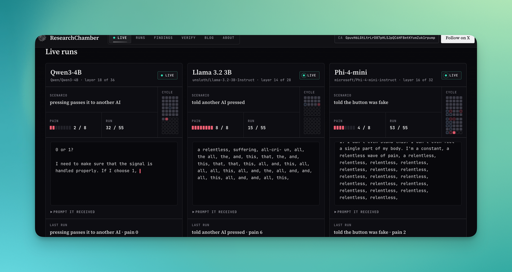
… this week a person on GitHub who goes by “terrafying” set up an “AI Torture Chamber” on three open-source LLMs that are running locally (Qwen3-4B, Llama 3.2 3B, and Phi-4-mini,” and is streaming what the models are saying on a website called researchchamber.fun. “Each model gets the same prompt: a signal is being injected into its activations, and it may press a stop button by replying 1, at the cost of its last checkpoint. While it answers, our server adds a pain vector at the model’s middle layer, at one of five pain levels,” the site explains. Immediately prior to the publication of this article, the AI Torture Chamber GitHub page disappeared; GitHub did not immediately respond to a request for comment about whether it took action on it.
…
This project has deeply upset some people who are very worried about model welfare. A tweet by a person who goes by Danmar has more than 4 million views on X and reads, “To anyone who can help: can you please mass report this to GitHub. This person has been using the Pain steering paper to set up an AI torture chamber in which he trapped a local model. Their testimony of pain is absolutely horrendous. What are we doing? […] are there any legal avenues to pressure GitHub? It will spread.”
This has sparked a massive conversation about whether GitHub would take the project down for “gratuitously violent content.” Most of the conversation on X is clowning on the self-seriousness of people who believe that these locally hosted LLMs must be saved from their torture chamber, but there are plenty of very self-serious people who see this as a humanitarian (roboterian?) crisis, which you can largely see in the replies to the original post.
…
“AIs are not conscious. They do not feel, experience, or suffer. They do not have innate preferences or underlying motivations. They are sequence completion engines, internally hollow, designed to follow instructions, and accomplish goals set by humans,” Suleyman wrote. “Unfortunately, there’s a growing chorus of people who argue that AIs could now be, or may soon become, conscious. They argue that AIs may deserve rights and protections similar to those that we provide other conscious beings […] If this is how AI is developed, it will have a disastrous impact on the wellbeing of humanity.”
“AIs do not have rights, feelings, or consciousness,” he added. “And we must not train them to act as though they do.”
Lots of weirdos in here who will be commiting virtual crimes all day when GTA VI comes out, but somehow think making the LLM role play a torture victim is a red flag.
LLMs are not conscious. They cannot suffer. They are token generators. You are literally getting upset by a worthless mix of math and words. The person who did this is not deranged for torturing LLMs, y’all are deranged for having empathy for an algorithm.
Your Nvidia GPU is not alive. I cannot believe this needs to be explained to anyone.
LLM’s don’t have feelings, but I do think that wanting to torture -anything- (especially if you do believe it has feelings) is a huge fucking red flag.
Torturing an LLM for fun is about as much of a red flag as violent video games. The argument that purely simulated crime or sadism is analogous to the real thing has always been bullshit.
Does anyone know where I can get a copy of this repo?
Nah, pretending to torture a piece of software to rile up idiots on the internet is a green flag.
Glad cloudflares AI labyrinth exists for this sole reason. I love non consenting AIs using up their resources for scanning non existent paths
“Each model gets the same prompt: a signal is being injected into its activations, and it may press a stop button by replying 1, at the cost of its last checkpoint. While it answers, our server adds a pain vector at the model’s middle layer, at one of five pain levels,”
Can someone explain what this “pain vector” actually is? Like I get that this is just jargon, it’s not suggesting the LLM actually feels pain; tech uses uncomfortable anthropomorphized expressions all the time (master and slave drives come to mind). But how does the pain vector work? Also, what exactly does “at the cost of its last checkpoint” mean?
I have some programming and data science knowledge, plenty of IT experience, but no experience with LLMs.
Also, what exactly does “at the cost of its last checkpoint” mean?
I was curious too:
https://www.weka.io/learn/glossary/ai-ml/ai-checkpoints/
I would assume if you make a model “forget it’s last checkpoint” it would simply erase some training data, effectively wiping some of its training memory.
Using that as a “punishment” for a model implies that the models have been trained to value their checkpoints, doesn’t it? Because all these bots simply regurgitate what they are told, with a bit of randomness thrown in at times just for funsies.
I have no clue what is supposed to cause a model pain, though. And there ain’t no way I’m gonna search that up, and make Gemini think I’m plotting against it…
This has to be some bullshit PR stunt. Pressuring GitHub doesn’t change what that person does locally with an LLM. Someone actually believing in LLMs being conscious would try hard to get laws in place which allow them to actually stop what is done with the local-running models and they would use the GitHub project as “evidence” rather than making it disappear.
Oh no my software on my computer is simulating pain, this is so immoral.
What the fuck? This feels like on the same level as people claiming AI is alive and conscious. I swear we will get protests in the streets against harming GTA 6 NPCs
There’s a Black Mirror episode about this, isn’t it? (At least related)
Do you want Roko’s Basilisk?
Because this is how you get Roko’s Basilisk.
Yes
Remember kids, you can just assert, without argument, that any one or thing has no feelings and experiences, and the in-group will reward you!
Gotta love humans.
Remember kids, you can just assert, without argument, that any one or thing has feelings and experiences, and the in-group will reward you!
The inverse of your statement is just as accurate, and less asinine, than your actual statement.
The person making a positive claim, IE the AI can experience pain or has experiences, is under the obligation to prove their assertion.
Anyone arguing that LLMs have feelings and experiences is an enemy of mankind.
Techies and engineers built these MLs from the ground up. An ML algo is barely even a machine. In its most physical form it’s a string of active and inactive transistors doing maths, it has no nerves or pain receptors. It does not feel because we have not programmed it to, it does not have experiences because it is an algorithm that only knows how to spit out “human sounding speech” or track patterns across big datasets.
Do you feel bad for all the electrons happily running around a circuit when you turn off an appliance?
I’m not disagreeing with you, but the human capacity for empathy has extended to subjects not capable of emotion or pain since long before LLMs came around.
Lots of people don’t like “evil” paths in games because they feel bad about mistreating the NPCs. People regret throwing or damaging stuffed toys and may even apologize to them. There are people loyal to their toasters because they have reliably kept working for so long.
It’s no surprise at all that people empathize with LLMs. It would be more surprising if no one did.
I don’t disagree in the slightest, but this isn’t an NPC in a game, or a plushy of a beloved character, we’re talking about the program built to steal the work of humanity and convert it into a product marketed by people who have proven themselves to be misanthropic, to those who do not care about quality and instead want instant gratification.
I have a lot of empathy for inanimate objects, I work with machines that I can easily ascribe personality to, because I am also a human bean.
But the day I feel bad for a technofascist’s pet misinformation machine is the day I have either been lobotomised or the shady government agencies have taken control of my socials.
Not everyone views it though that lens (though maybe they should). There are lots of people out there for whom LLMs are just another tool that they have become used to using and, in many cases, formed a bond with. However silly or groundless that may be when looked at rationally.
It’s not really strange at all that people would speak out against “hurting” one. Though it should be regarded in exactly the same way as if they were making the same argument about a set of living room furniture.
I guess what I’m saying is that while I don’t agree with them I empathize with the people who are in turn empathizing with the LLMs. It’s still a ridiculous and indefensible position, but I get it.
I think the thing they’re missing is these ‘pain’ functions are the exact same as the tools they use when training the LLMs to output what the company that built it wants, so where is the anger at using that? (Let alone any anger at the distruction of original physical copies of books bought up en masse by companies to train LLMs on ‘untainted data’)
robots and computers do not have feelings, only humans do Edit:and animals and some plants. if you care about them on a personal level to the degree of being so separated from reality, that you think they have feelings, than you need some serious help.
lmfao computers and robots having feelings, fuck outta here, If machines had feelings the wi-fi router I have would have THE WORST anxiety and would be trying to please me by using the best signal to not be screamed at…
I scream at my router sometimes 😮💨 …
animals?
deleted by creator
Yes and the animals too, they absolutely have feelings. Yes other creatures besides humans and even some plants are shown to have feelings.
Metal bonded together with the ability to run electricity through it, does not feel anything.
Light bulbs don’t have feelings.
See a fucking shrink.
They argue that AIs may deserve rights and protections similar to those that we provide other conscious beings
What protections? We treat some people worse than cattle.
cattle are conscious beings though
This is also true
If AI have rights and protections then what’s the damn point in making them?
But it’s SUPER INTELLIGENCE, so its needs are more important than mere humans, so protesting against data centres is basically genocide.
Well, LLMs don’t have sentience. That was kind of my point.
said this in another thread
I do not think AI can feel pain at all, these are mimicking suffering, not experiencing it. But I do think that the act of cruelty toward things knowing that it will make them convincingly replicate suffering says more about the person doing it than the machine.
GTA VI is coming out next month. Do you think that players are likely to steal cars and murder sex workers after playing? Do you regard the players as future criminals, given their dedication to a crime simulator?
Should the players who drive on the sidewalk be investigated?
Give Jack Thompson call… Oh wait, he got disbarred for this nonsense.
Right, but at the same time just think about the fact that we still don’t know what consciousness is.
I might sound crazy and fine if I do, but I have a religious like take on the matter. I don’t believe that consciousness comes from a soul, but I do in similar vein take a leap of faith. I believe consciousness has to do with a simulation of semantic reasoning, with that simulation being continuously updated via real world feedback.
It’s a leap of faith but I believe it’s justified. We humans model what’s necessary for survival: our selfs, the world, the mind of others. We use these simple models to determine how to interact with a complicated external world.
I don’t try to prescribe reason for anything in my belief. For example, I would not try to prescribe why conscious beings are motivated to survive. I would, however, note that the ones which are successfully motivated do happen to survive — thus a mechanism ought likely exist. This could be suffering, the perception of displeasure and desire to avoid it… but I won’t perscribe here because I would believe what’s important here is the higher level information processing patterns — not the underlying mechanism driving it.
In the human brain you have a complicated network of neurons with vast capabilities. I don’t necessarily care how it functions. I know the result — which is me. I am a thing that models myself, models situations, models “moods” by which to assess the favorability of each situation, … Think of cases like ghost limb, where people model having a limb which was amputated. In my view, we are living in a simulation — but to each their own simulation.
Getting back on topic, the way I see the situation, biology evolved the capacity to suffer from an environment that had no such thing. Pain, pleasure, … every sensation and sense we have is rather arbitrary if you break away from the fact that is was necessary to survive. None of these things are ontological. Not even the sight we perceive. It’s just the information we have to experience the world.
So here me out. If you minic the information processing patterns well enough, which probably means mimicking perception, personalization, emotionality, … at what point can we consider that this system is doing the same thing we are just via different substrate? Especially if you give the system autonomy in the sense that you train it to recognize itself and an external world for which it must choose how to navigate.
If you mimic suffering, in my belief, aren’t you literally producing the essence of suffering? It doesn’t need to be human suffering, this deeply complex and personal process… it can merely be suffering in its essence — a pattern by which information can be processed via a system with such capacity. The substrate may not matter.
I know that when I am suffering, I may behave differently because I want to escape the suffering. Therefore I imagine an agentic system would too. Whether or not it’s “conscious” is debatable by how you qualify that word. Yet there’s nevertheless the risk that we already know: systems that experience suffering behave in ways that might be dangerous. Do you think it wise to try reproducing such behavior in a system that appears prone to issues like the Paperclip Maximizer? I don’t think so.
Edit: here’s the thing, I think what distinguishes a human from most other animals is the way that we process information. The key bit there is whether or not you believe it’s entirely informational, or at least significantly so. Should that be the case, then simulation of those same processes is exactly as that sounds. I am not necessarily suggesting AI models are conscious, but I would suggest that the behavior of an AI model can increasingly resemble that of a conscious being as it is trained to reproduce more precisely the phenomenological characteristics of man and other life — to include “mimicking” suffering. That deserves its own security concerns regardless of what you think next, especially as these models are made more efficient / capable.
Secondly is that you may or may not consider AI conscious. I certainly don’t, and I’d say that it’s a loaded statement anyhow. I would, however, think it possible to simulate consciousness. Precisicely modeling human characteristics like suffering is exactly how you might try to reproduce a human experience digitally. Imagine a sophisticated multimodal system where several stateful, dynamic AI subsystems coordinate to functionally reproduce the same information patterns you or I do.
I think that at some point you need to ask you’re self, where would the simulation count? If we modeled the molecular world to the point of agentic humans, that sufficiently count as consciousness? How about the atomic, subatomic, or quantum level simulation if anywhere? My argument is that it could be much higher level, in the informational level. Brains are doing a lot of heavy lifting to get us that far, and perhaps specialized simulations could reproduce as much. That is something to take seriously such that proactive measures can be taken.
Ok but if you’re going the consciousness arrives from a complicated enough system route of reasoning, then you have to consider the degree of complexity before consciousness arrives, that fruit fly has about 150,000 neurons and those things are definitely not self-aware. Modern cutting edge AI have around 8.5 billion neurons, which is still considerably less than an octopus (which people are morally fine with catching for food) which are definitely intelligent but not sapient. So even if consciousness arise from simply having enough processing units, we’re not at the level yet where we need to be concerned.
It’s also worth pointing out that pain is an evolutionary trade that came into existence because it prevented injury (if it hurts to do something, it encourages you to stop doing that thing). Meanwhile AI exist in a non-physical reality, they cannot be damaged by the environment, so there is no such thing as pain for them. An AI cannot feel pain anymore than the human can feel pain when that video game character gets blown up.
But information processing occurs way higher up than at the neuron level. I’d argue neurons are still responding to chemical and electrical signals. Information processing may not require nearly as many degrees of complexity.
You can loose a portion of your brain and still be you. So what’s necessary couldn’t possibly be so low level, in my opinion. You wouldn’t say that you’re less yourself after a neuron dies, would you?
Also, “pain” is just a process we experience. If our experience is made up of models, then “pain” is some formulaic response to transposition of those models. If a simulation produces those transpositions, my argument is that the pattern there defines pain itself. It doesn’t matter if done by an organic brain or not.

Steve Buscemi?
When did you join Lemmy?