I learned Japanese so I could read stuff like this.
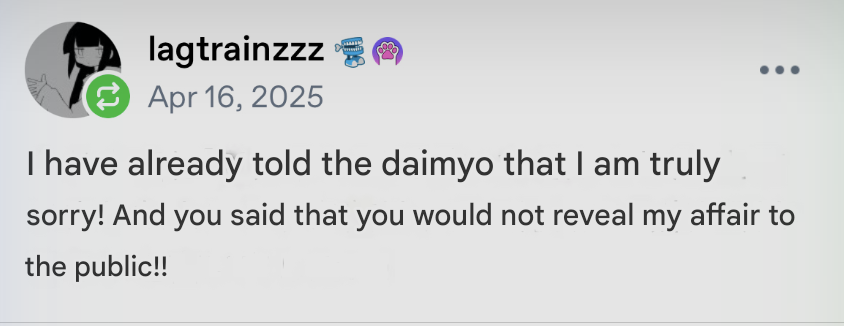
Per AI translation : " I have already told the daimyo that I am truly sorry ! And you said you would not reveal my affair to the public !! "
Yeah!
Me too!
Also, I might be mistaken, but I think this is poorly worded in japanese
As a professional translator and a mod of a translating community, yes, it’s crap.
Especially because they’re trying to emulate the samurai dialect. It’s inaccurate, but deserves points for trying!
you’re right, firstly, と can’t be used on its own like that to mean “and”, then 我の is not a thing, it’s 我が but really it should have been 僕の or something
and I think it should have been either 明かすな or 明かさないで, 明かさない is just plain negative
我のdefinitely is a thing (ware no), especially if you’re someone important like a daimyo. And と言いました is correct because you’re quoting (or reporting) something another has said.
Edit: oh I guess the speaker isn’t the daimyo. In any case, ware-no is grammatically correct.
Right! It’s like someone who knows what keigo is but otherwise has a very basic understanding of japanese grammar and compensated for that with google translate.
For the single と, I think they could’ve used a そして right?
I also tried to read that outloud and choked on the 我の. I first pronounced it like “wa no” then realized it was weird and went with “ware no” but something was still off. The weirdest part for me was that he literally quoted himself apologizing to the daimyo instead of using reported speech.
My japanese is still very basic, I had to use a dictionary for 浮気 and 公衆. I guessed what 明かす meant (idk of that’s the right infinitive) based on the kanji, then confirmed.
Yeah, I’m not sure either but it does look a little odd.
Would edo period Japanese even have exclamation marks?
It would probably not… Then again, this is the internet.
何!!
Pls share :(
The Apple translate thingie says:
I’ve already said to the daimyo, “I’m really sorry”! And you said you wouldn’t reveal my affair to the public!!
Thank you :)
You’re going to get us all shipped off to the shogun for a bushel of rice over this
So, was the daimyo’s daughter named Yuri?
Yuri Gagarin did it again!