cross-posted from: https://infosec.pub/post/53563321
The Seeed Studio XIAO ESP32-S3 Sense is for tinkerers, not super-spies.
OpenAI told me in an email that it used its own AI models to analyze data from the device—including forensic images of the data stored on the device—to find their suspect.
They will never find out
Actual image of OpenAI and Kash Patel’s FBI meeting:

Could have just hacked the TV like a normal pro.
Seriously how does a multibillion tech company keep a smart tv in their confrence rooms? It has to be modified and its microphones removed, or forever offline at least
These meeting rooms have commercial displays but also they have the google or microsoft office speakers anyway
Why hack it? Just buy the data from LG
China’s already got control of that!
Openais products must be shit at coding if it unsuccessfully encrypted the sdcard as asked to
What good will onboard encryption be if the device is seized? They will just figure out how to decrypt.
I guess you’d need to set up asynchronous encrypt / decrypt keys, then move the data encrypted end to end. The target device can do the decrypting, while the bug only does encrypting.
Thats not how encryption works when implemented properly
How so?
If you ever intend to decrypt the data, don’t you need a decryption key?
I think my point stands, you’d need this device to be only capable of encryption. Otherwise, anyone with access to the device can decrypt it. So it goes without saying, you’d have to push the data to a second device which handles decryption.
You can have an encryption key that can’t decrypt the data. That’s what public and private keys are. The device can have a public key to encrypt the data, and then it can only be decrypted with the attacker’s private key. No need to even get it out of the device, you can also perform the decryption on the same device. Just don’t store the private key in there.
Right, but that’s referring to where the encryption key lives, what kind is used, and how. In the above comment, I’m just stating you need a decryption key.
Earlier I rose that you could store the decryption key on a separate device. I thought 0x0 was contesting that idea as “not how encryption works when l implemented properly.”
No
Oh… so how do you decrypt your data without a decryption key? Don’t tell me you use a password…
Do you store your password on the device in cleartext? Thats stupid.
Just no, youre plain wrong.
Obviously not. Do you store your false equivalency fallacies on the internet in clear text? Apparently so, but I won’t call you stupid for it.
- How do passwords get stored? Encrypted.
- How do they get read? Decrypted.
- What performs the encryption? Keys.
- What can the keys be derived from? Passwords.
- Where are those keys stored? On the damned device.
Are you telling me, fuck all to the popular mantra that: if they have physical access to device, you’re boned?
State sponsored forensic programs bypass TPM and shit all the time, requiring physical access.
So where is your hypothetical security coming from? To me, it sounds like you’re needlessly giving me a hard time on a subject I probably understand better than you.
If they are insinuating that because it’s cheap it’s not sophisticated think again.
You can get motion sensors based on quantum dynamics principles for just $1, they are in all phones today, and those are based on extremely sophisticated theory and production methods. But industry has managed to find ways to make them extremely cheap despite that.So putting the sophisticated in quotes based on the low price is an oversimplification.
That said, there are probably more sophisticated miniaturized options for spying than the cheap gadget they used.Sophisticated is commonly used as a comparison to other sinilar things. So a sophisticated computer in 1980 is different from one in 2026 because technology advanced significantly. A lot of common features on cell phones would have been called sophisticated 20 years ago, but not anymore.
In this case sophisticated is intended to mean relative to other similar devices. Since this is a commodity electronic device you can easily buy for under $13 it doesn’t fit the common usage of ‘sophisticated’ for 2026.
Language is messy. I sometimes think of sophisticated as the opposite of simple.
It kind of is, isn’t it?
Edit:
Goddam people are contrarian here.
https://www.merriam-webster.com/thesaurus/sophisticated
Simple is the first antonym (opposite) stated, and simplistic is number 4.
This place is a cesspool sometimes 🤡No, it isn’t.
(Source: https://www.youtube.com/watch?v=ohDB5gbtaEQ461260665047)
I stand corrected. 😋
Complex is the opposite of simple.
Complex is a synonym of sophisticated within this use case
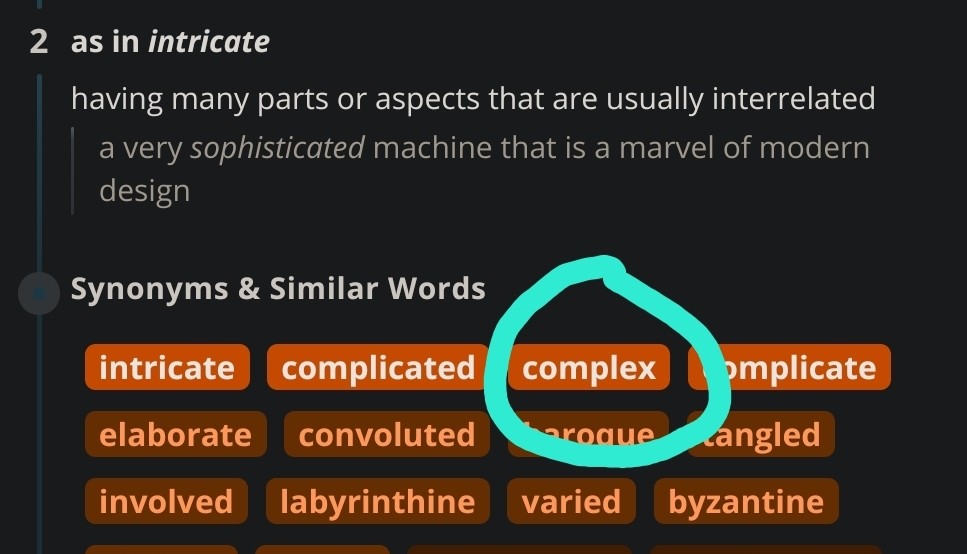
One does not exclude the other:
https://www.merriam-webster.com/thesaurus/sophisticated
Simple is literally the first antonym to sophisticated!
Depends on what you mean by is.
And depends on what you mean by depends. 🤔
🤗
A computer from the 80’s is still a sophisticated device.
Not compared to modern top end hardware, which is how the word is used in this context.
Ok, but you could also say a simple pc about a modern pc, that does not mean it’s actually simple. It’s because it is used in place of ordinary. And ordinary also doesn’t mean simple in the literal sense. Even a “simple” mobile phone is in fact not simple.
Which sensor in phones uses quantum states? Do you mean things like SQUIDs? They are a completely different beast than classical sensors like MEMS.
Motionsensors
Do you mean the Soli radar? That ended up in what, 2-3 phone models altogether?
Most phones do not have motion sensors.
No literally a common motion sensor.
https://en.wikipedia.org/wiki/Quantum_sensorQuantum sensors have applications in a wide variety of fields including microscopy, positioning systems, communication technology, electric and magnetic field sensors.
One of these are the perfectly common motion sensor that detects if you move your phone, which is based on quantum phenomenon, like the phase shift between photons send in different directions.
None of the current phone IMUs utilise quantum phenomena for measurement. They’re MEMS/FOG/RLG systems.
Quantum IMUs are the size that requires rack mounting.
OK but still the GPS using timing based on an atomic clock in space is absolutely sophisticated, and that is in even the cheapest smartphones today.
Your claim was quantum phenomena utilisation in phone sensors.
Let’s stop moving the goalposts please.
I mean everything electric is a quantum sensor not to defend anything
edit: further g sensors and accelerometers implemented by piezoelectricity are quantum sensors. They just use materials that make the sensing easy
If the device doesn’t use quantum effects directly, it isn’t a quantum sensor.
Otherwise words have no meaning and textbooks would call 1860’s steam engines electric quantum engines because materials are held together with electric effects and atoms have quantum properties.
I am extremely ignorant on these things. If what you say is true, it stands to reason that all the claims that “only 3 companies can produce memory chips” are most likely bullshit.
I hate the way the world is going right now.
The 3 major makers Samsung, SK Hynix and Micron dominate the market, but they are definitely not alone. especially not since China has entered the market in force.
I have a couple of these in a drawer somewhere. Who should I “hack”?
Hack the planet!
Super Intelligence.
deleted by creator
a microphone is cheap. you don’t need a battery if you can plug it in somewhere, be it a real power source, or a usb port or display output on something else.