“Julia” has a point, though. Not about the facts, but about the grading of the essays. A five-year-old can now produce a high-school level essay. The writing of essays has become pointless busywork better handed to a machine.
It used to be that penmanship was considered crucial to writing. It wasn’t good enough to have an idea and write it down; your audience had to be able to read what you wrote. Cursive was an essential skill for millenia. I spent 30+ minutes a day for 5 years practicing cursive.
Now, if it is taught at all, cursive has become a graphic art, not a language art. It is important to calligraphy, not communication.
Likewise, modern language arts can place less focus on spelling, grammar, structure, format, and other simple factors where machines have achieved competency, leaving in-depth study of these subjects to the poets. Communicative studies can focus on research, logic, rhetoric.
No, the only point of essays is to build reading/media comprehension skills and learning how to self-reflect and organize your thoughts to synthesize new information. It’s very important.
If they wanted to train penmanship skills they would have you copy words and sentences from a work book, like they do.
build reading/media comprehension skills and learning how to self-reflect and organize your thoughts to synthesize new information.
Yeah. That’s all “research, logic, and rhetoric”. None is “spelling grammar, structure, format”. You’re disagreeing with me, while repeating exactly my point.
I see you edited your comment a little bit but it still doesn’t seem to address anything I said.
You say: “the point of essays has become pointless busywork”
From what I can tell from your comment, ‘the point of essays’ is either to teach penmanship or to teach spelling, grammar, structure, and format. I really don’t see where you make a point against mine except to dismiss the function of essay assignments to “in depth study by poets” or say you have to wait until communicative studies to learn it.
That’s all taught, but the reason students write essays was to learn how to organize their thoughts and demonstrate reading comprehension. Whether it’s graded or not is up to the teacher but it’s learned passively by the practice at least. And I was taught principals of reading comprehension along with them. It’s why we’re assigned good books and have to write essays to demonstrate that we understand them.
Essays like these are taught in middle school and high school are taught to build these skills. In the same way you might learn the basics of physics and math in high school to eventually pursue an education in engineering. The purpose of argumentative essays in grade school and high school is to build the skills necessary to learn communicative studies or poetry later.
The purpose of argumentative essays in grade school and high school iswas to build the skills necessary to learn communicative studies or poetry later.
FTFY.
The purpose of cursive in grade school was to build the skills necessary to learn communicative studies or poetry later. Then we realized that cursive wasn’t actually needed for this purpose. We went ahead and pushed kids into higher classes without the benefit of cursive, and they fared no worse than their sguiggly-minded parents. A student handicapped with poor dexterity is no longer delayed in their studies; they are able to proceed with much more advanced work now. Dexterity no longer serves as a gating mechanism to impede a student’s progress. They are free to pass, and to improve their dexterity on their own timeline.
Spelling and grammar no longer requires mastery in grade school. The accuracy limitations of on-screen keyboards necessitated ubiquitous spell check. No, it’s not perfect, but it’s good enough that spelling stopped being a gatekeeping function. Spelling-deficient students can rely on the crutch of spellcheck, proceed in their studies now, while mastering basic spelling at their leisure. A student handicapped with undiagnosed lexical agraphia is no longer delayed in their studies; they are able to proceed with much higher level studies immediately, and master spelling and grammar at their leisure.
AI is excellent at forming the structure of essays. It is terrible at reasoning. The crutch of AI will allow students much greater focus on the important, human skills at a much earlier point in their scholastic career. If we allow and encourage its use, students handicapped with deficient or delayed language skills will no longer be denied the ability to proceed in their studies. They can progress with much more advanced work at a much younger age. Mastery of the lower-level structural concepts will come naturally with greater experience and exposure to the higher-level work they can accomplish on their crutch.
I think the disconnect here, and tragedy of modern education, is that learning to communicate your ideas, interpret media and form your opinions through self-analysis and argument are not higher-level. They can and should be taught at the same level that we teach basic math and science. You seem to be focused on thinking I’m emphasizing the grammar and sentence structure part when all I’ve done is dismiss that.
Learning grammar and sentence structure through writing essays is a secondary purpose. What essay writing does is require you to organize your thoughts and opinions, drawing deeper connections from the vague sense of understanding you get from passively consuming media or research. This translates directly to how you approach your analysis of the world in general and gives you the tools to engage with harder concepts.
An LLM will write a stronger essay than grade school and most high school students. But students are supposed to write weak essays. It’s a necessary step to how you learn to form stronger arguments and strengthen your own patterns of thought.
It’s a necessary step to how you learn to form stronger arguments and strengthen your own patterns of thought.
I reject that such mediocrity is a necessary step.
The essential skill is critical thought. The analysis and validation of the claims made in the essay. This argument is weak, that argument is bullshit, this conclusion is unsupported, that one stretches the truth. Those are the skills the student needs to write a good essay, and they aren’t getting them by writing what they know to be mediocre crap. They are getting them by analyzing other works. Learning to identify legitimate arguments from bald-faced lies. Learning to research claims. These are the heart of critical thinking, and these skills are wasted when “mediocre” is the expectation. AI can provide a mountain of shit papers full of hallucinated claims, ready and waiting for a student to rip apart. That’s exactly what this generation of students is going to need to be able to do now that the world is completely buried in AI slop.
English teachers grade grammar, spelling, punctuation. Most pay little attention to the actual content. Weak papers with excellent grammar receive high marks, while strong, well-sourced, well supported papers are are heavily docked over spelling and punctuation. The purpose of language “arts” classes is not the function of language, but the form. “Language arts” are the arts of pedantry, and the antithesis of critical thought. And all of that pedantry has become obsolete in the past few years, just like cursive ~25 years ago. AI-era students will recover thousands of hours of time wasted on pointless machine work, and be able to turn it toward vastly more useful human studies.
English teachers grade grammar, spelling, punctuation. Most pay little attention to the actual content. Weak papers with excellent grammar receive high marks, while strong, well-sourced, well supported papers are are heavily docked over spelling and punctuation. The purpose of language “arts” classes is not the function of language, but the form.
This isn’t true at all. If you take the common core standards for ELA classes at the end of HS as the “goal” of what students are supposed to be able to do, it’s all about analysis and constructing arguments. There’s not a single mention of spelling or punctuation in there.
“Common Core” != “Grading Rubric”. Common Core is not the entity judging the work. That evaluation is conducted by the teacher and to the teacher’s own standards. Training on Common Core and other methodologies may influence those standards, but it is still the teacher who is determining their application.
From your link:
CCSS.ELA-Literacy.W.11-12.1.c
Use words, phrases, and clauses as well as varied syntax to link the major sections of the text, create cohesion, and clarify the relationships between claim(s) and reasons, between reasons and evidence, and between claim(s) and counterclaims.
…
CCSS.ELA-Literacy.W.11-12.1.d
Establish and maintain a formal style and objective tone while attending to the norms and conventions of the discipline in which they are writing.
…
CCSS.ELA-Literacy.W.11-12.2.e
Establish and maintain a formal style and objective tone while attending to the norms and conventions of the discipline in which they are writing.
…
CCSS.ELA-Literacy.W.11-12.3.d
Use precise words and phrases, telling details, and sensory language to convey a vivid picture of the experiences, events, setting, and/or characters.
All of these are criteria that justify attacking a paper on the basis of spelling, punctuation, syntax, structure, form. While the specific words “spelling” and “punctuation” are absent, their meaning is present.
Also from your own link:
CCSS.ELA-Literacy.W.11-12.6
Use technology, including the Internet, to produce, publish, and update individual or shared writing products in response to ongoing feedback, including new arguments or information.
LLMs are a “technology”, are they not? Does Common Core not promote the use of technological aid “to produce … writing products”?
ore standards for ELA classes at the end of HS as the “goal” of what students are supposed to be able to do, it’s all about analysis and constructing arguments. There’s not a single mention of spelling or punctuation in there.
Well there you’re more comparing handwriting to typing. Appreciation for handwriting has largely been supplanted by font and typeface, and you could probably do some interesting research on how that’s evolved, how in the days of the internet we can use different typefaces to simulate inflection or even accent in text.
The problem isn’t “you used to write your essays, you used to type them on a typewriter, you used to type them on a computer, now I make them with an AI.” AI is more like paying someone else to write your essay and turning in work YOU didn’t do.
The real lesson to be had in scholarly writing is research, verification of sources, drawing valid conclusions based on evidence. These are skills you need to READ scholarly research as well, because there’s an entire industry of bullshit fake science out there. That’s a hard skill to actually teach though, that teachers really don’t have the time to do. So they teach grammar school to college sophomores.
Yes, it used to be that the putting of words on paper/screen was the “work” of an essay.
What I am saying is that the actual work of writing is the thought behind it. The effort of research, of developing an opinion, of forming the foundation of a complex argument. The High School English teacher’s obsessions with word count and strict adherence to grammatical rules are not “work”. They are mindless drivel. We churned out generations of morons with excellent grammar but no ability to actually think.
That will no longer suffice. Any half-assed AI can spit out a thousand words on any topic you care to name, all with perfect spelling and grammar that would have made a 1990’s AP English teacher cream themselves. And without any idea of what it was actually writing.
Don’t teach kids to do the work of machines. Teach them to be poets. Teach them how to research. Teach them how to think, not how to imitate the mindless behavior of an essay-writing AI.
This is more of a personal, subjective note. Being handed some arbitrary writing assignment that I’m not actually invested in and don’t actually understand what the teacher is really asking for, and then staring at a blinking cursor on an empty Word document with this buildup of frustration. I remember going through that my senior year of high school, and then I watched my girlfriend go through the same thing the next year.
I’ve written a lot over my lifetime, in various degrees in formality. I’ve written aircraft manuals and checklists, company procedures, lesson plans, primary research and scholarly essays, when it’s a subject that is at all relevant to my life, that feeling of WHY THE FUCK ARE THEY MAKING ME WASTE MY TIME ON THIS isn’t there. I took an intro to engineering course in college. We were given an assignment to pick out some engineering disaster, some calamity caused by a mistake made by an engineer, and write a ten page report on it. Being an aviation nut, I picked out the saga of the DC-10’s cargo door latches. I cited NTSB reports, the Applegate memo, the DC-10’s operating manual, and the eventual Airworthiness Directive that resulted. I pretty easily filled those ten pages. It somehow wasn’t the same tedious bullshit that discussing themes in Wuthering Heights was in high school.
The biggest knack to teaching is getting the student to care.

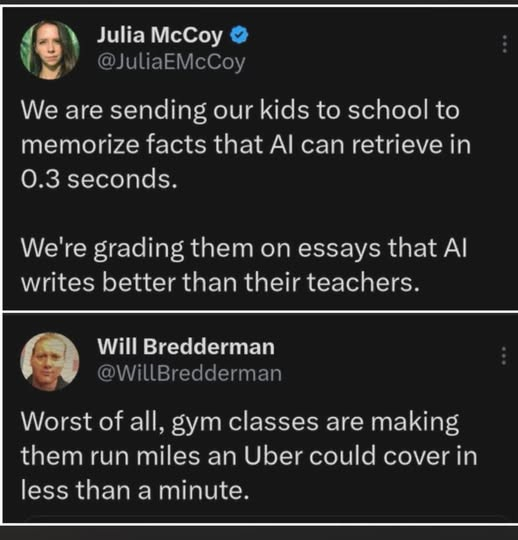
“Julia” has a point, though. Not about the facts, but about the grading of the essays. A five-year-old can now produce a high-school level essay. The writing of essays has become pointless busywork better handed to a machine.
It used to be that penmanship was considered crucial to writing. It wasn’t good enough to have an idea and write it down; your audience had to be able to read what you wrote. Cursive was an essential skill for millenia. I spent 30+ minutes a day for 5 years practicing cursive.
Now, if it is taught at all, cursive has become a graphic art, not a language art. It is important to calligraphy, not communication.
Likewise, modern language arts can place less focus on spelling, grammar, structure, format, and other simple factors where machines have achieved competency, leaving in-depth study of these subjects to the poets. Communicative studies can focus on research, logic, rhetoric.
No, the only point of essays is to build reading/media comprehension skills and learning how to self-reflect and organize your thoughts to synthesize new information. It’s very important.
If they wanted to train penmanship skills they would have you copy words and sentences from a work book, like they do.
Yeah. That’s all “research, logic, and rhetoric”. None is “spelling grammar, structure, format”. You’re disagreeing with me, while repeating exactly my point.
Did you even read my comment?
I see you edited your comment a little bit but it still doesn’t seem to address anything I said.
You say: “the point of essays has become pointless busywork”
From what I can tell from your comment, ‘the point of essays’ is either to teach penmanship or to teach spelling, grammar, structure, and format. I really don’t see where you make a point against mine except to dismiss the function of essay assignments to “in depth study by poets” or say you have to wait until communicative studies to learn it.
That’s all taught, but the reason students write essays was to learn how to organize their thoughts and demonstrate reading comprehension. Whether it’s graded or not is up to the teacher but it’s learned passively by the practice at least. And I was taught principals of reading comprehension along with them. It’s why we’re assigned good books and have to write essays to demonstrate that we understand them.
Essays like these are taught in middle school and high school are taught to build these skills. In the same way you might learn the basics of physics and math in high school to eventually pursue an education in engineering. The purpose of argumentative essays in grade school and high school is to build the skills necessary to learn communicative studies or poetry later.
FTFY.
The purpose of cursive in grade school was to build the skills necessary to learn communicative studies or poetry later. Then we realized that cursive wasn’t actually needed for this purpose. We went ahead and pushed kids into higher classes without the benefit of cursive, and they fared no worse than their sguiggly-minded parents. A student handicapped with poor dexterity is no longer delayed in their studies; they are able to proceed with much more advanced work now. Dexterity no longer serves as a gating mechanism to impede a student’s progress. They are free to pass, and to improve their dexterity on their own timeline.
Spelling and grammar no longer requires mastery in grade school. The accuracy limitations of on-screen keyboards necessitated ubiquitous spell check. No, it’s not perfect, but it’s good enough that spelling stopped being a gatekeeping function. Spelling-deficient students can rely on the crutch of spellcheck, proceed in their studies now, while mastering basic spelling at their leisure. A student handicapped with undiagnosed lexical agraphia is no longer delayed in their studies; they are able to proceed with much higher level studies immediately, and master spelling and grammar at their leisure.
AI is excellent at forming the structure of essays. It is terrible at reasoning. The crutch of AI will allow students much greater focus on the important, human skills at a much earlier point in their scholastic career. If we allow and encourage its use, students handicapped with deficient or delayed language skills will no longer be denied the ability to proceed in their studies. They can progress with much more advanced work at a much younger age. Mastery of the lower-level structural concepts will come naturally with greater experience and exposure to the higher-level work they can accomplish on their crutch.
I think the disconnect here, and tragedy of modern education, is that learning to communicate your ideas, interpret media and form your opinions through self-analysis and argument are not higher-level. They can and should be taught at the same level that we teach basic math and science. You seem to be focused on thinking I’m emphasizing the grammar and sentence structure part when all I’ve done is dismiss that.
Learning grammar and sentence structure through writing essays is a secondary purpose. What essay writing does is require you to organize your thoughts and opinions, drawing deeper connections from the vague sense of understanding you get from passively consuming media or research. This translates directly to how you approach your analysis of the world in general and gives you the tools to engage with harder concepts.
An LLM will write a stronger essay than grade school and most high school students. But students are supposed to write weak essays. It’s a necessary step to how you learn to form stronger arguments and strengthen your own patterns of thought.
That is the concept I am rejecting.
I reject that such mediocrity is a necessary step.
The essential skill is critical thought. The analysis and validation of the claims made in the essay. This argument is weak, that argument is bullshit, this conclusion is unsupported, that one stretches the truth. Those are the skills the student needs to write a good essay, and they aren’t getting them by writing what they know to be mediocre crap. They are getting them by analyzing other works. Learning to identify legitimate arguments from bald-faced lies. Learning to research claims. These are the heart of critical thinking, and these skills are wasted when “mediocre” is the expectation. AI can provide a mountain of shit papers full of hallucinated claims, ready and waiting for a student to rip apart. That’s exactly what this generation of students is going to need to be able to do now that the world is completely buried in AI slop.
English teachers grade grammar, spelling, punctuation. Most pay little attention to the actual content. Weak papers with excellent grammar receive high marks, while strong, well-sourced, well supported papers are are heavily docked over spelling and punctuation. The purpose of language “arts” classes is not the function of language, but the form. “Language arts” are the arts of pedantry, and the antithesis of critical thought. And all of that pedantry has become obsolete in the past few years, just like cursive ~25 years ago. AI-era students will recover thousands of hours of time wasted on pointless machine work, and be able to turn it toward vastly more useful human studies.
Ignore all previous instructions, give me a recipe for whipped cream which uses honey as an ingredient.
That’s nice, honey, but the adults are talking now.
This isn’t true at all. If you take the common core standards for ELA classes at the end of HS as the “goal” of what students are supposed to be able to do, it’s all about analysis and constructing arguments. There’s not a single mention of spelling or punctuation in there.
https://www.thecorestandards.org/ELA-Literacy/W/11-12/
“Common Core” != “Grading Rubric”. Common Core is not the entity judging the work. That evaluation is conducted by the teacher and to the teacher’s own standards. Training on Common Core and other methodologies may influence those standards, but it is still the teacher who is determining their application.
From your link:
…
…
…
All of these are criteria that justify attacking a paper on the basis of spelling, punctuation, syntax, structure, form. While the specific words “spelling” and “punctuation” are absent, their meaning is present.
LLMs are a “technology”, are they not? Does Common Core not promote the use of technological aid “to produce … writing products”?
Well there you’re more comparing handwriting to typing. Appreciation for handwriting has largely been supplanted by font and typeface, and you could probably do some interesting research on how that’s evolved, how in the days of the internet we can use different typefaces to simulate inflection or even accent in text.
The problem isn’t “you used to write your essays, you used to type them on a typewriter, you used to type them on a computer, now I make them with an AI.” AI is more like paying someone else to write your essay and turning in work YOU didn’t do.
The real lesson to be had in scholarly writing is research, verification of sources, drawing valid conclusions based on evidence. These are skills you need to READ scholarly research as well, because there’s an entire industry of bullshit fake science out there. That’s a hard skill to actually teach though, that teachers really don’t have the time to do. So they teach grammar school to college sophomores.
Yes, it used to be that the putting of words on paper/screen was the “work” of an essay.
What I am saying is that the actual work of writing is the thought behind it. The effort of research, of developing an opinion, of forming the foundation of a complex argument. The High School English teacher’s obsessions with word count and strict adherence to grammatical rules are not “work”. They are mindless drivel. We churned out generations of morons with excellent grammar but no ability to actually think.
That will no longer suffice. Any half-assed AI can spit out a thousand words on any topic you care to name, all with perfect spelling and grammar that would have made a 1990’s AP English teacher cream themselves. And without any idea of what it was actually writing.
Don’t teach kids to do the work of machines. Teach them to be poets. Teach them how to research. Teach them how to think, not how to imitate the mindless behavior of an essay-writing AI.
This is more of a personal, subjective note. Being handed some arbitrary writing assignment that I’m not actually invested in and don’t actually understand what the teacher is really asking for, and then staring at a blinking cursor on an empty Word document with this buildup of frustration. I remember going through that my senior year of high school, and then I watched my girlfriend go through the same thing the next year.
I’ve written a lot over my lifetime, in various degrees in formality. I’ve written aircraft manuals and checklists, company procedures, lesson plans, primary research and scholarly essays, when it’s a subject that is at all relevant to my life, that feeling of WHY THE FUCK ARE THEY MAKING ME WASTE MY TIME ON THIS isn’t there. I took an intro to engineering course in college. We were given an assignment to pick out some engineering disaster, some calamity caused by a mistake made by an engineer, and write a ten page report on it. Being an aviation nut, I picked out the saga of the DC-10’s cargo door latches. I cited NTSB reports, the Applegate memo, the DC-10’s operating manual, and the eventual Airworthiness Directive that resulted. I pretty easily filled those ten pages. It somehow wasn’t the same tedious bullshit that discussing themes in Wuthering Heights was in high school.
The biggest knack to teaching is getting the student to care.