
Hi there everyone,
Let me start this by saying that this is an honest question. I figure nobody would be better suited to answer my question than a group laser-focused on the negatives of the technology.
I see these types of memes a lot and see statistics of gallons consumed in a lot of articles I read. What I don’t understand though is where the water goes that it can’t be reclaimed or naturally return from a gas to a liquid.
As a kid(long ago), I was taught of the cycle of rain and the conversion between gases and liquid. It’s my understanding that when a liquid is used to cool something, it also follows the same conversion process as it cools.
Could someone explain to me what’s going on in this process where the 264 billion gallons of water used in the meme do not return to a liquid state?
I would appreciate any insight into the process that seems to defy this cycle that I am missing. Like I said prior, my knowledge of this process ended in middle school science class so I’m confident that I’m missing something.
Thanks for your time!
Future historians? LOL… after this blunder, mankind is going right back to the 18th Century and they’ll be bitches in the fields again or starve.
First of all, in general it depends what kind of water is used - river, lake, ground water - but in this case it’s almost always easily accessible river and lake water, because it’s the cheapest (surprise, surprise).
This is actually much better than it would have been with underground aquifers, because those take long years to refill.
However, whenever you collect river or lake water and evaporate it, it’ll almost never return as rain in the exact same place. Partially because that’s just how it works, and partially because climate change is affecting rain patterns almost everywhere.
So if you quickly use up half of an entire river - a good amount of the water will return as rain, but away from the river, so the river will still shrink. This is bad, because ecosystems depend on rivers and lakes, including people. It also doesn’t mean new rivers or lakes will be created elsewhere. All our current lakes and rivers have been created over millenia. Depending on where all that extra rain falls - the water may not even have a positive impact, e.g., because it’ll cause a flood.
Depending on the specific geographic location, some of the water may be completely wasted, because the rain will fall into the sea. In the middle of the country (US) it’s pretty much 0%, but closer to the shore it may be nearing 100%.
There’s also the problem of some data centers ignoring ecological regulations, and dumping all kinds of waste into the same rivers they use for cooling. There was at least one case of an xAI data center seriously polluting a river.
The single biggest issue is just the scale of water extraction. Most of humanity’s water use has been slowly growing over thousands of years, with appropriate infrastructure built and ecological research conducted. Not exactly true in the US (go figure), but I’m simplifying.
Big cities obviously use a lot of water, too. But they were built and populated over up to 300 years (or much more outside North America).
Now imagine adding several big citties worth of water consumption, all in just a few years, without any ecological oversight.
Excellent write up. Thank you for putting in the effort, this really helps.
There was at least one case of an xAI data center seriously polluting a river.
Wait, same xAI that was using methane generators to run their datacenters in Tennessee, right?
It almost seems like destroying the planet is their actual goal and if they’re lucky they generate petabytes of generated CSAM and “Mecha Hitler” as a treat.
Thats not how closed water systems work. There’s a reason there’s no real data behind the watershortage doomsayers.
First sentence is true second isn’t. Most of the water consumption comes from electricity generation. It’s like 5% 95%.
Also there’s no such thing as a truly closed system. But there are ones that use very little water to maintain pressure.
-
Most of the DC’s are using open-loop cooling, it’s far cheaper. If they’re using city water, they’re using aquifer supplies
-
If one does use closed-loop cooling, they’re simply using power to pump the cooling. Guess what type of cooling power large plants require?
Open loop using aquifer water, which is a miserable idea. Closed loop ends up using surface water by proxy or best case gas turbines which is straight up CO2.
The best we could hope to do is put up huge solar arrays + battery, but they’ll never do that, the upfront cost would be enormous.
It’s not like any of this is being designed to run responsibly. It’s all the least money they can spend for the max profit.
-
The 264 billion gallons absorb enough energy from the data center to evaporate. They turn into a gaseous form and rise into the sky where they become clouds. The clouds will eventually precipitate and turn into rain, but it might take months and months, and it probably won’t happen in dry areas with low rainfall. It might even happen over the ocean, turning the clouds into undrinkable salty seawater.
It might even happen over the ocean, turning the clouds into undrinkable salty seawater.
Well, I mean, doesn’t water evaporate from the ocean constantly and then also become rain?
To be clear it’s still a huge problem due to redistribution issues especially in drought stricken areas, but I feel like the ocean is actually like the main source of freshwater precipitation globally, right?
Sure, but we don’t usually use rain for drinking. It first has to pass through the ground and be pumped up.
The problem is that data centers are basically skipping the one step where humans have access to the water.
I think they’re using potable drinking water too. So we pay for it to be treated before data centers use it.
Why.
Edit: yes I know, the reason is that it costs more money
If you want to have water evaporated, you want it to not contain too much gunk otherwise your “evaporation pot” will get muddy real quick (not defending ai, just giving their rational)
Water has to be balanced before being pumped through the facility, or it will corrode or calcify the piping. DCs use municipal water so they don’t have to cover the cost of balancing themselves.
I don’t think the amount of evaporation from the ocean increases based on how much water is in the ocean at a proportional rate.
Probably not, but we’re in luck! As data centers accelerate climate change we’ll get more evaporation as the average ocean temperature continues to climb
Not to mention the oceans cover 2/3 the surface of Earth, so any precipitation only has a 1/3 chance of being on land. And then of course as others have mentioned that doesn’t mean it will rain in an accessible area or where it is most needed.
You want a hurricane? That’s how you get hurricanes
plus whatever anti-corosives and other [[accumulating] forever[?]] chemicals added that remain
I always assumed that distilled water (water turned to vapour, and re-condensed) is purified in the process.
The issue is that even when data centers don’t evaporate the water completely, their waste water has a much higher concentration of contaminants (because a bunch of the water evaporated out, concentrating everything that doesn’t evaporate). This makes it undrinkable.
That depends on how it’s recondensed. For distilled water you need a sterile collector.
Fine, I’ll do it.
I’m a bit uneducated on this, so maybe its a dumb question… But couldn’t saltwater be used for cooling as well? We have desalination plants, I’m sure there has gotta be a way to use the water for cooling and eliminate the freshwater problem completely, right? I’m assuming it is just that they don’t want to spend more money?
Salt water is really hard on plumbing. At best it could be used as a secondary cooling loop.
I’m assuming it is just that they don’t want to spend more money?
It’s always this.
Saltwater is corrosive so it would cost more to maintain.
Desalination takes a lot of energy. In order to use seawater without rusting the pipes, they’d need to make even more CO2.
Desalinization is a very costly process, so you would do it only if there are really no other alternatives. If if you can’t get cheaper in other ways
It evaporates. They could cool it back down and reuse it, but that would increase costs even more and corporations like money.
Also, “but it remains part of the water cycle” is irrelevant. Of fucking course it does; we’re not talking about nuclear fusion here! But what matters isn’t how much water exists, it’s how much usable water exists and when it evaporates it stops being usable.
Isn’t the same true for nuclear power plants?
yes but we get value from power plants - power.
LLMs just suck up more power.
Yes, or anything with evaporative cooling towers. (Coal-fired plants have them too, because they’re associated with the steam turbine part, not the nuclear part.)
However, it should be wasting a lot less water (relative to the benefit) since the whole point is to extract as much energy from the steam as possible before it exits the turbine. Power plants have the “excuse” that if they tried to cool the steam any further they’d have to spend power to do it, which would reduce overall efficiency and thus be self-defeating.
Hello I’ve used this as an example video in the past, I occasionally work on cooling towers and usually the maintance is not always the best, so I can’t imagine what they’re doing since it’s kinda hush hush for people working on them so I can’t give information on exactly how their systems work but evaporative is pretty common and air chilled sites are something I come across too but not as often as evaporative[Evaporative cooling tower](Evaporative cooling tower https://youtu.be/dg4L_xdaIIs)
When the water evaporates it leaves behind the minerals so it builds up quick. There’s maintance that you have to do on them and depending on the place there are regular water changes since the minerals build up. Places that have hard water I would assume change more often plus there is legionnaires from the water too since it’s a good environment for bacteria and other shit. Which can also get put into the air as droplets and assuming you have a humid day it could also make the workers or people near sick. Plus water usage can vary since maintance is not always top priority for companies so a bad float valve can passively just dump water back into the city system
Funny enough the towers in this video have been replaced with newer ones, that also leaked out of the sides xD
deleted by creator
As a kid (long ago), I was taught of the cycle of rain and the conversion between gases and liquid. It’s my understanding that when a liquid is used to cool something, it also follows the same conversion process as it cools.
Yeah the water used in evaporative cooling on the data canter roofs does later condense as rain somewhere again, but the issue is that it will be far away from the location by then, so that’s no relief for the local water network that is taxed by the demand.
To tack onto this; For recondensing the water you also need a cold area, if you’ve got a heat source such as thousands of computers worth of cooling towers and hundreds of diesel/gas turbine generators running in one spot, you’ve got a recipe for a hot, humid patch of atmosphere in the area surrounding the datacenter which can hold a lot of water and take it away fron the area.
Do this enough times in one country and it creates a heat dome of hot humid air made of their drinking water, combine that with global rising temperatures and any human or animal body in the area becomes physically incapable of shedding any heat because the outside temperature and humidity prevents their sweat from evaporating.
Nah, they ran out of water because they found a way to make money with it.
Pray they don’t find a way to use oxygen or we’ll have PerriAIR from spaceballs
https://www.joburgetc.com/news/ai-data-centers-fresh-water-usage-cooling-recycled/
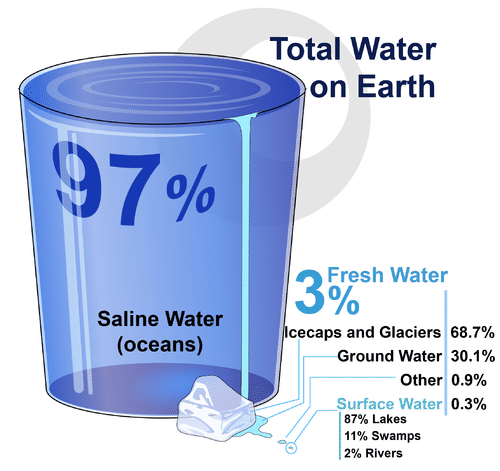
TLDR: They use evaporative cooling, so the clean drinking water is taken from the water supply and distributed to the air. Yes, the rain cycle works and the water isn’t destroyed, but the water molecules are distributed places that are no longer readily available. Drinking water supplies like aquifers, reservoirs, etc. are depleted, but weather patterns do not necessarily replenish them, particularly weather patterns distorted by climate change.
Hahaha, future historians. Rich.
You’re right about the rain and evaporation in general. It’s the rate of evaporation and source of water that is in question.
This is a simple answer and there’s a lot of factors but generally, it’s the rate of usage.
Farms in California are facing drought - the water cycle hasn’t stopped, but the water source in the mountains is drying up as climate change impacts are felt - so they extract groundwater (which is not replaced at the rate of extraction). This groundwater evaporates or leaves inside the vegetables they grow and falls as rain but not where it was extracted from.
A datacentre in Wisconsin pulls water from a Great Lake, is used for cooling, the water evaporates, and rains somewhere else. The Great Lake shrinks. It’s the same effect.
Plus, the water may be treated (contaminated) by the datacentre. It may be using treated drinking water.
Copying from another thread on this, but the focus on water use over electricity and emissions of datacenters does not make sense. It’s just helping datacenter by focusing on the wrong environmental issue because they are not a major contributor to water use.
Agriculture, and animal agriculture specifically, are the super dominant water users. Even in water scarce places like the Colorado river

Animal agriculture also pollutes ground water, and at a far higher rate and frequency. They create toxic algae blooms are from the runoff which means high nitrate levels in the local water level. Cancer rates are elevated nearby animal farms
https://www.sciencedirect.com/science/article/pii/S0013935126006286
Meanwhile electrical usage is delaying fossil fuel plant closure, leading to new ones, leading to backup generator use, etc. Datacenters are projected to go from 5% of electricity use to 15%. I keep seeing 5x the number of posts on the water usage than emissions. It’s letting datacenters get away with their super high emissions with so much less attention to it
Yeah but Agriculture produces stuff we actually need instead of automating people’s jobs and child porn
Though not all agriculture is equal. We don’t need to be eating nearly so much meat, dairy, and so on though. Per capita consumption has gone through the roof in previous decades. If we are concerned about water, we should also be also reducing our consumption. For a number of other reasons too
You are right but I find it quite hard to raise arguments against cattle raising when the animals existing allow for a better outcome than if they didn’t.
An objective example: I’ve recently read a paper on how two landrace breeds, one of sheep and one of cows, are more effective at preventing wild fires than conventional cleaning efforts through the use of machinery to manage vegetation. The animals selectively eat vegetation that is usually source of ignition or facilitates fast spread of fire, reach areas where machines can not go and do not destroy the landscape. Apparently there are good indicators that the grazing may even lead to soil improvement and more biodiversity.
Regardless, there are people trying to remove these animals from the landscape. I don’t agree. Better to have animals roaming around, living their lives, than burning fuel to try and make a poor work at cleaning what otherwise are abandoned tracts of land and then have wild fires destroying everything in they path, often caused by malicious human hand.
The better approach for those cases is to let the wild grazers back into the land. Cattle and other modern farm animals don’t graze like wild life did
Cows and bison differ in all behaviors — including how they stand, move and graze. Cattle spend almost double the time grazing — 45-49 percent — in comparison to bison — who spend just over a quarter of their time doing so (26-28 percent).
[…]
The types of plants bison and cattle prefer to graze on are also remarkably different. Unlike cattle, who prefer to graze steadily on flowering herbs like clover, milkweed and sunflower, free-roaming bison cover a much larger area, grazing on different varieties of grass, such as perennial grasses, but leaving certain areas of the prairie untouched.
https://sentientmedia.org/cattle-ranching-terrible-for-biodiversity/
Moreover in the net, having cattle on those is usually a net negative to the ecosystem
Livestock farmers often claim that their grazing systems “mimic nature”. If so, the mimicry is a crude caricature. A review of evidence from over 100 studies found that when livestock are removed from the land, the abundance and diversity of almost all groups of wild animals increases
There are no wild grazers here. Closest to it are wild boars and a few introduced deers. I’m in Portugal. Old country. We had a large number of landraces, adapted to specific locations, mostly bred for free range grazing and foraging but the commercial breeds nearly wiped them out.
If we assume that’s true, this still leaves the emission side of things which are quite high for cattle. Cattle are some of the heaviest emitters because of how they digest. Are we at least in agreement that the production level and thus consumption level should come down?
We do.
I still remember meat being treated as a speciality dish, not a daily presence. And the animals were allowed to grow slowly. Herds were smaller. The most affordable meats were normally rabbit, chicken and pidgeon, all animals most people raised at home.
Industrial farming is a monstrosity.
Worth noting that generating electricity is typically the second leading user of water behind agriculture. A 5 -> 15 percent bump will consume a lot more water unless new generation doesn’t spin a turbine with steam, just not at the data center itself.
That’s much more of a fair argument than the cooling loop water that I haven’t heard articulated. Keeping the old fossil fuel plants alive does keep that water use there. That being said, the majority of the new grid capacity is solar and wind which are the two types of power generation that don’t need to really use steam. Was about 88% solar + wind in 2025 capacity additions in the US and 91% from solar + wind + battery in Q1 2026
Put a straw in your hand.
Get a mouthful of ice cold water
Blow it through the straw out the other side.
Feel it cool your hand? See how its dispersed out to god knows the fuck where? Never returning in any significant volume to replenish the cup it was drawn from
Thats basically whats going on.
Billions of gallons of drinkable water, wasted because data centers didnt want to pay the extra cost for a closed loop cooling system. putting enormous strain on water systems that are already at or beyond their breaking points and are not able to replenish at even a fraction of the rate that they are being drained from.
even closed loop can only recycle the same water so many times
Industrial closed loops rarely use water. and will last a very long time. besides, lets be generous and just assume its running nothing but water water and some anticorosive additives. it will run on that water for a very long time, and changing out that water once a year is still trillions of gallons less than what would be consumed otherwise.
It’s like your car’s radiator. They flush their systems occasionally, but it’s really not much… at least not locally. Who knows what’s going on at the power plant where the electricity is being generated? Arid states should be strictly requiring closed loop systems of data centers and electricity producers alike.
It’s not an extra cent for a closed loop cooling system and your straw analogy is closer to closed loop in how it works. They use open loop because vaporising water takes a lot more energy than heating water. You get a lot of more cooled. The alternative is to run a ton more AC at lower efficiency since the hot side of the AC won’t be cooled fast enough.
They’re doing it to use less electricity since electricity is expensive. In a way, it’s a good thing. Until you factor in droughts
There’s ones that use evaporative cooling, meaning they draw water off of a river/lake/creek (or domestic water supply) and cool through putting that water into the air. Lots of power plants do this exact thing, especially nuclear power plants.
There’s ones that use closed cycle cooling, like a bigass water cooled PC. The water generally stays inside. It periodically needs to be cycled.
There’s also measures out there that account for all of the water needed to produce all of the components. The water used for that is one time usage.
Are these things “using up” water? Sure, some of them are in the sense they are accelerating evaporation. Some are using very little water.
Some datacenters use no water because they’re thousands of times smaller than these new ones.